- Have any Query?
- acharyaviyatprajna@gmail.com


International Women’s Day—Lived, Not Celebrated
March 19, 2026
ଯା ଦେବୀ ସର୍ଵଭୁତେଷୁ
June 8, 2026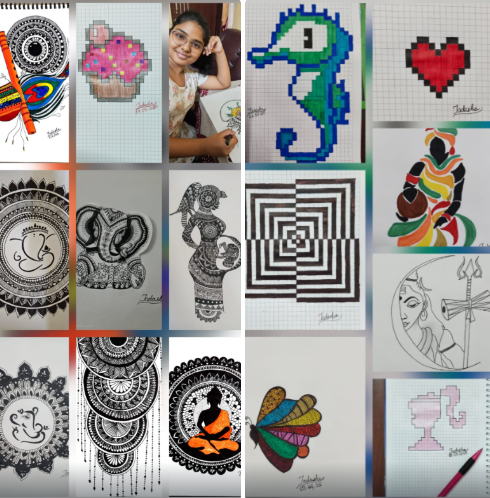
DrViyatprajna Acharya
Professor, Biochemistry
—————————-
After three years of homeschooling, I joined a rural school to resume my academic journey. A year later, I returned to my hometown, Burla. Unlike most children, I was strangely fond of examinations—though I never quite knew why. Perhaps it was the isolation and monotony of staying at home for three long years, or simply my love for studying and the urge to evaluate myself.
Exams were a cakewalk for me. Under the brilliant guidance of my Bou (mother), I had devoured volumes of novels, biographies, comics—anything I could lay my hands on. I was always ahead of my peers. But when I entered Class 7, things felt different. The curriculum was heavier, and the exam pattern had changed. This was the half-yearly exam—the first in my new school.
On the very first day, we had MIL (Odia literature) and Drawing. There were no unit tests or weekly assessments—just two major exams a year, and we learned at our own pace.
By God’s grace, I had a good memory. Studies were never the issue—drawing was. A triangle with three mangoes, rangoli patterns, drawing a cow—oh dear! That one subject terrified me. Thankfully, drawing disappeared after the 7th board exams, but until then, it was a formidable hurdle.
Now, to the point—cheating.
I still wonder which eccentric mind set that question paper. We were asked to either draw a mahout riding an elephant or a woman cutting fish with a paniki—a traditional tool used for chopping vegetables, meat, or fish. When had we ever been taught such drawings?
I felt utterly helpless. Looking back, I realize our imagination had never really been nurtured. Government textbooks had only a few black-and-white images, often faded. There was little encouragement for creative expression, and no one seemed to care.
Left with no option, I set aside my pride as a topper, swallowed my embarrassment, and whispered to my friend in front,
“Reena, show me your elephant once…”
With great difficulty, she tilted her notebook slightly. What I saw barely resembled an elephant—but it gave me courage. I recalled the chitaa (alpana/kolam) my mother used to draw during Margashira Gurubar, welcoming Goddess Lakshmi with rice-paste motifs leading from the courtyard to the altar.
“God helps the helpless,” they say. Luckily, I was seated in the corner of the last bench. Had any teacher seen what was taking shape on my paper, my ears would have burned red with embarrassment! Somehow, passed the exam with bare minimum marks.
Art, in those days, was never taken seriously. If someone excelled, people would simply remark, “God has gifted them talent”—and that was the end of the discussion.
A few broken crayons were all we had—nothing like today’s children, who carry kilos of colours and sophisticated tools even at school level! At school, the art classes were converted to leisure periods. A teacher came and managed the class, just monitoring and usually knitting something with wool, a common practice those days. We were allowed to chit-chat with slow murmurs and pass our time happily.
I always felt a mix of envy and admiration for those who could draw well. Slowly, by observing my best friend, I learned to sketch a pretty girl’s face on the back pages of my rough notebook. Thankfully, drawing was not part of the Class 10 board exams to haunt me further.
In higher secondary school, when I first drew a microscope diagram in my botany record, I felt a deep sense of satisfaction. But it was short-lived. My botany teacher remarked,
“Did you trace it or use carbon paper?”
I had never even heard of tracing paper! When I asked a friend, she tried explaining with gestures, comparing it to the oily paper inside biscuit tins—which I barely understood. Much later, I finally saw tracing paper and even used it during urgent situations.
By now, you must have realized how limited my knowledge of art was. I didn’t even know what tracing or carbon copying meant! And yet, the only time I had ever truly “copied” was that elephant drawing. Ironically, I then wondered—perhaps my drawing was good enough for the teacher to suspect it was copied!
That thought boosted my confidence. I found modern arts easier and kept experimenting. Yet, somewhere, my artistic journey remained confined within that shadow of imitation—of plagiarism.
And yet, that incompleteness—the unfulfilled desire to truly learn art—has found expression today through the brushes and colours of my daughters. They, too, began as little “plagiarists” like me, but gradually their right brains are finding their way toward originality. And I, for one, am more than satisfied—even if they occasionally borrow inspiration.
It is heartening to see that schools today are giving due importance to art education. This balance between creativity and logic is essential. While art stimulates the right hemisphere of the brain, mathematics and science engage the left. Exposing children to both ensures holistic development, shaping them into balanced individuals.
Happy World Art Day-2026
Warning: Trying to access array offset on null in /home/u480314390/domains/drvpacharya.com/public_html/wp-content/themes/themes/betheme/includes/content-single.php on line 259