- Have any Query?
- acharyaviyatprajna@gmail.com


ନିରକ୍ଷରଙ୍କର ଅସହାୟତା
September 12, 2026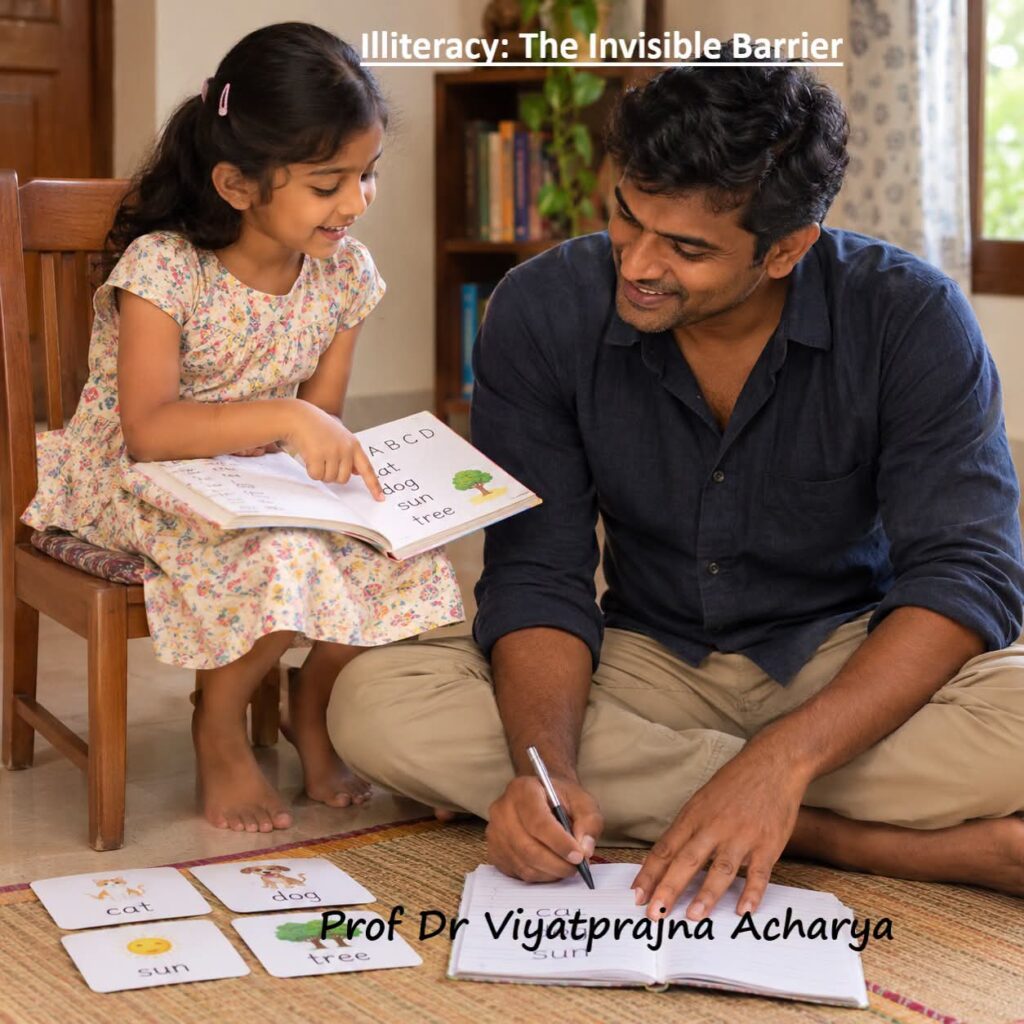
Dr Viyatprajna Acharya
Professor, Medical Biochemistry by Prof V P Acharya
———————————————————–
Have we, the literate ones, ever stopped to think about how deeply those who cannot read or write might feel their inadequacy? How helpless they must sometimes feel—almost like being blind in broad daylight!
Close your eyes for a moment and imagine this. Suppose you are a domestic helper. If you fail to reach work on time, you may have to face severe scolding. Yet, you do not know how to read the time on a clock!
Or imagine a mother—with countless dreams in her eyes. She herself has never been educated, but she is determined that her children must study. However, she is illiterate. Sometimes she cannot understand her child’s homework, and at other times she cannot make sense of a notice sent by the school. All she can do is ensure that her child reaches school on time.
Once, I hired a young man as a driver on a part-time basis. Everything about him was good. Like everyone else, whenever he found a little free time, he would become engrossed in his mobile phone. But strangely, he never replied to my WhatsApp messages promptly.
I could not understand it. His phone was always in his hand. Why, then, did he not reply to my messages, even after seeing them? Yet, whenever I transferred money to him online and informed him about it, he would immediately respond with a thumbs-up and invariably write, “Thank you.”
Needless to say, this behaviour sometimes irritated me a little.
One day, I asked him how much he had studied.
He replied that he had never gone to school.
I was surprised.
“So, how do you use your mobile phone?” I asked. “I usually write to you in English, even when I am communicating in Odia. How do you read my messages then?”
He hung his head, scratching his ear, he replied,
“Madam, when I return home at night, I ask someone to read them out to me. Then I ask them to write the reply for me.”
Aiyooo….!
Deep within me was a feeling of regret. Since our childhood, we have heard about adult education programmes. Yet, even today, has illiteracy not been eradicated? Does that mean that even in 2026, we still need to continue such programmes?
From then onwards, I started recording my messages and sending them as voice notes. Even then, I could not fully understand the depth of his difficulty.
One day, he himself said to me,
“Madam, look! An auto-rickshaw of such-and-such company is passing in front of us. I know the name of the company, but I cannot read it.”
Ah!
That was the moment I truly understood. It must indeed feel like being blind despite having perfectly good eyes! Letters were like pictures to him. The words meant nothing. The billboard models must be his only attraction, vaguely knowing about the products. He must be blinding himself to so many information around him!
The “Thank you” that he used to send me so promptly must have been appearing in his auto-type suggestions. Perhaps he had memorised it and learned to use it whenever necessary.
“Alright,” I asked him, “how do you keep track of your accounts?”
“Madam, I can manage that much using my mobile phone,” he replied.
“So, that means you can at least recognise English numerals. Very good! From tomorrow onwards, we will study a little every day.”
And thus began our little adult literacy programme.
He was eager to learn English quickly. I would ask him to watch a few videos on YouTube and teach him a few letters every day. Sometimes, I would even involve my younger daughter in teaching him.
Of course, I occasionally received some chiding from my family!
“Whomever you employ,” they would say, “you immediately start treating them like a member of the family!”
There would be differences of opinion, of course. But eventually, everyone would cooperate with me as well.
However, when one’s mind is consumed by the constant struggle for livelihood, where is the peace of mind to concentrate on studies?
After some time, he left his part-time job with me and accepted a full-time job elsewhere. He moved to Baleshwar. I do not know whether he continued his studies after that or not. However, I feel I had kindled the fire within him, if he would have kept it aglow, the learning will definitely continue.
The young man had picked up many English words simply by hearing others use them. Perhaps he used them so that people would not realise that he was illiterate.
But sometimes, he would get caught!
For example, once he asked me,
“What work do you do?”
I replied, “I am a doctor and a professor. I teach students in a medical college.”
He responded,
“Oh! Pappesar!”
I corrected him twice. Finally, I gave up and accepted my new designation!
After all, sometimes I do feel like a “Pappu-Ishwar”—as though I have made a complete fool of myself!
That, however, is not the end of the story.
This experience made me realise something important: adult education today should not remain limited merely to teaching people how to recognise letters and write words.
Perhaps one reason many adults are not interested in conventional education is that they do not want a rigid, structured system of reading and writing. They are looking for skills that will help them live their everyday lives.
For them, it may be sufficient to learn how to read certain words in their own language and in English so that they can use a mobile phone, read signboards, or carry out transactions at a bank.
They are not looking to master grammar. Nor do they necessarily aspire to become another Samanta Chandrasekhar!
Basic mental arithmetic may be sufficient for their needs. What they truly need is financial literacy and money management, so that they can free themselves from the bondage of dependence and exploitation that often comes disguised as something “free.”
Therefore, even today, there is a great need for adult education centres that provide need-based education, rather than teaching people according to our convenience or following the same conventional methods that have been used for generations.
Such centres should give importance to practical knowledge—our Constitution, our rights and responsibilities, laws and regulations, principles of healthy living, food and nutrition, and basic health education.
Most importantly, we should ask the learners themselves what they need. Their needs should guide the way we educate them.
The purpose of literacy should not be limited to teaching someone how to sign a document or merely maintaining government records by showing that certain targets have been achieved.
Children, young people, and those formerly illiterate individuals who have themselves benefited from becoming literate thus, should also be involved in this movement.
Literacy should not merely mean the ability to recognise letters.
It should mean the ability to live with greater confidence, dignity, independence, and awareness.
= May All Be Well =
Warning: Trying to access array offset on null in /home/u480314390/domains/drvpacharya.com/public_html/wp-content/themes/themes/betheme/includes/content-single.php on line 259